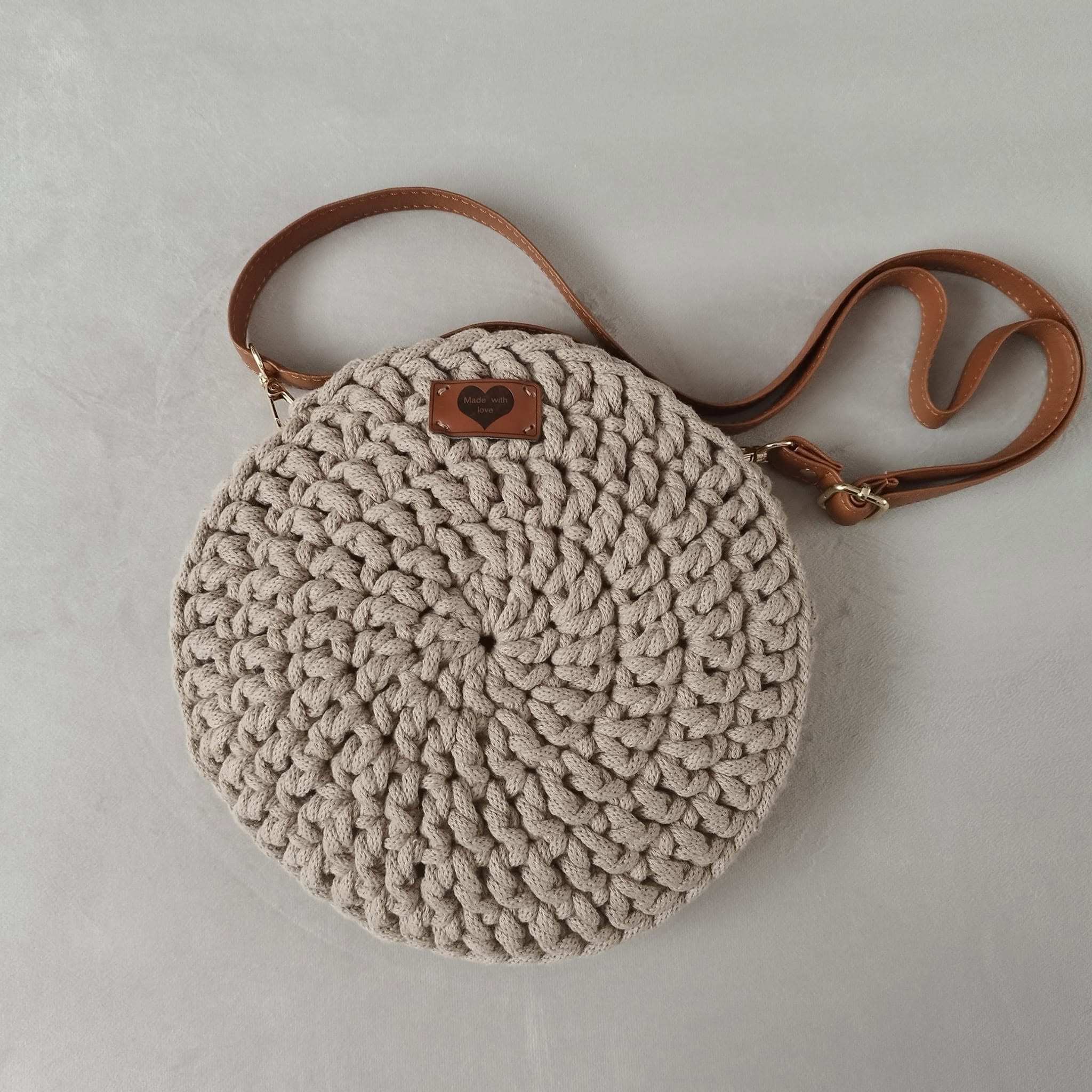
When someone asks me how long it takes to crochet a bag, my short answer is: a few evenings. That's true, but it's not the whole story. Before I make the first stitch, there's choosing the cord and the colour – and after the last stitch comes the finishing, which takes longer than you'd think.
In this post, I show how a bag comes together, using the Raspberry bag as an example: from skein to clasp. Along the way, I answer a question that's rarely asked outright but often hangs in the air – where the price of a handmade item comes from.
Before the first stitch – cord and colour
Why I buy less, but better
For my bags, I use cotton cord. I choose yarns that age well – ones that still look like yarn years later, not like plastic. I'd rather buy less but better, because a bag should last for years, not just one season.
Every dye lot of yarn takes colour a little differently. That's why I note on every product that the shade may differ slightly from the photo. It's not an excuse – it's simply a characteristic of the material I work with.
A colour that goes with what you already own
I choose colours that are easy to wear every day. Raspberry is bold but not loud – it pairs well with beige, black and denim, and on a grey day it provides all the colour an outfit needs. Bottle green looks different in every light: warm, almost emerald in the sun, dark and calm in the shade.
Stage by stage: how a bag is made
Base and body – where the shape is decided
This is the most important part of the work. How evenly and densely I place the stitches in the base and body determines whether the bag will hold its form or start to sag after a few weeks. The stitch in the Raspberry bag is dense and springy: it keeps its shape without being stiff, so the bag sits close to the body instead of sticking out.
With thick cord, every imperfection shows immediately. If the stitch is looser somewhere or a row has shifted, I unravel it and start again. You can't see any of that in the finished bag – and that's exactly the point.
Flap and strap
The flap should be soft but still hold its line. I crochet the strap from the same cord as the rest of the bag, so it moves with it and is exactly the same colour – no “almost matching” shades. It's long, so you can wear the bag over your shoulder or cross-body. The strap is actually one of the most painstaking parts: long and repetitive, yet it has to be even along its entire length.
Finishing: the clasp and weaving in the ends
Finally, I attach the gold snap clasp, which opens with a flick of your thumb. Then I weave in all the cord ends so they don't poke out or come undone with wear. It's the last, quiet stage that hardly anyone thinks about – yet without it, the bag wouldn't be finished.
What you don't see in the photo
In the product photo, you see the finished bag. You don't see what happens along the way:
- unravelling – because a few rows didn't turn out the way I wanted,
- checking that the strap is the right length to wear cross-body,
- trying the bag on myself to see how it sits against the body,
- the photos, description and packing – which I also do myself.
A handmade bag vs. a high-street bag – what's the difference?
I don't want to criticise anyone here – high-street bags have their place and their advantages, mainly the price. Still, it's worth knowing what you're paying for in each case.
- How it's made. My bag is made stitch by stitch, by one pair of hands, without machines. There are no seams joining pieces cut from ready-made fabric.
- Number of pieces. I make each item as a one-off or in just two pieces. Once it finds its owner, it disappears from the shop and something new takes its place.
- A different colour on request. I can make selected bags from the shop in another colour, as long as the right cord is available. In a chain store, you take what's on the shelf.
- Contact with the person who made it. If you have a question about care or something happens to it, you write directly to me.
Where the price of a handmade bag comes from
The Raspberry bag costs 159 PLN, and the large Ecru tote 219 PLN. Three things make up that price:
- Materials – the cord and accessories such as the clasp or strap.
- Time – several evenings of work on a single bag, plus everything that happens before and after the crocheting.
- Everything else a small brand involves – photos, descriptions, packing, talking to customers. Nobody does that for me, either.
I don't run a factory, and I don't pretend to. I'd rather make less, but make it well – and be honest about what it costs.
And a shawl? Why it “can take longer”
If a bag takes a few evenings, a shawl can take longer. Take the Sand shawl: it's worked in one continuous piece, from the darkest band to the lightest, so the colour transitions are smooth and nothing is sewn on anywhere. Each band has a different stitch – smoother in the darker sections, more openwork towards the cream edge. Every change of colour and stitch is a moment where you have to take care to keep the whole piece even.
If you'd like to see what's ready right now, take a look at the Handbags category. You can read more about who I am and what I work with on the About Me page. And if you like a bag from the shop but are looking for a different colour, write to me before placing your order. I usually reply within two working days.